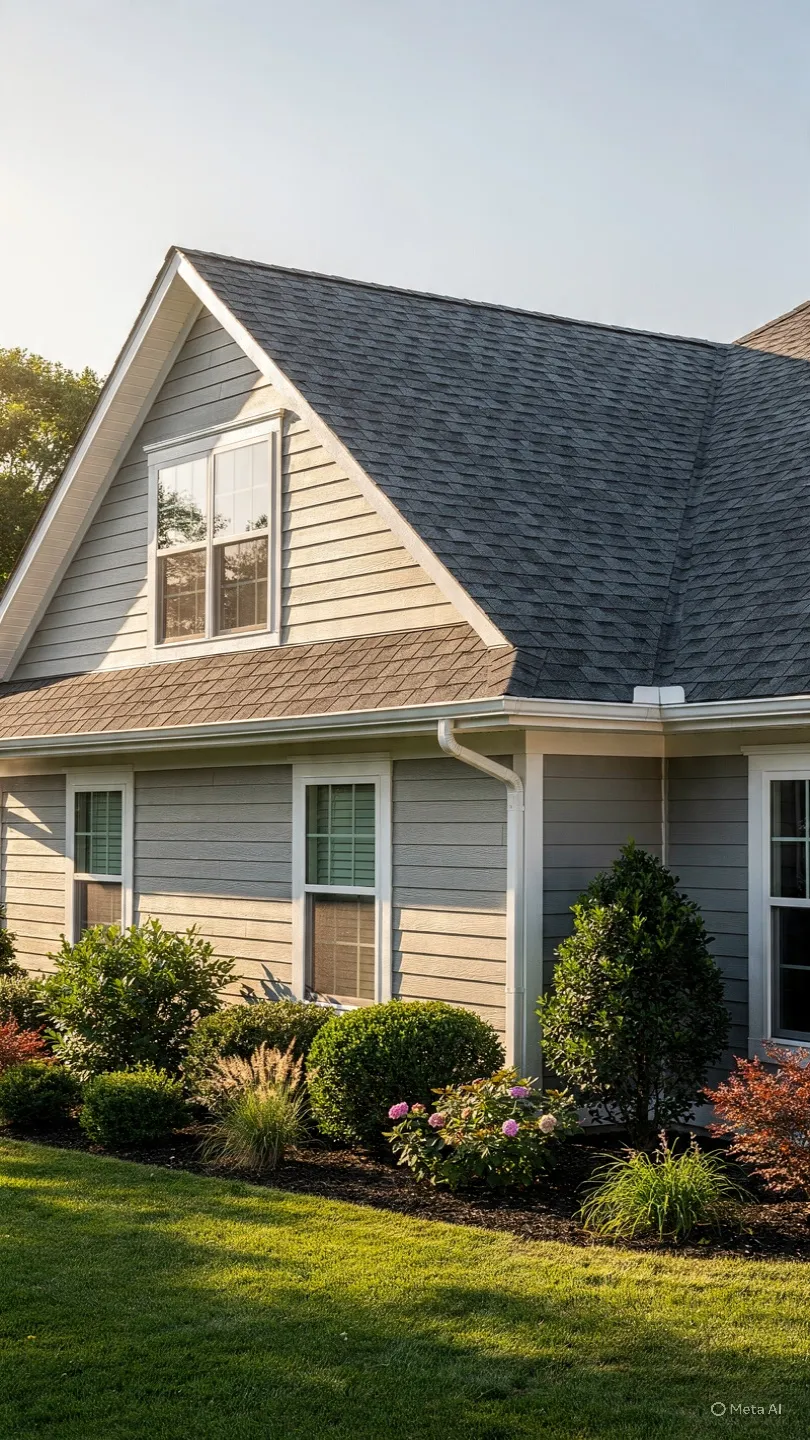
Roofing in the Chesapeake Bay Critical Area: What Actually Triggers Review
When a roof replacement inside the Chesapeake Bay Critical Area needs extra approval in Anne Arundel County, and when it doesn't.
If you own a house near the water in Anne Arundel County and you are about to replace the roof, you have probably been told that the Chesapeake Bay Critical Area is going to complicate it.
Usually it does not. A like-for-like roof replacement on the existing footprint is one of the least complicated things you can do to a house inside the Critical Area, and the reason is worth understanding, because it is the same reason that a handful of other roof jobs genuinely do trigger review.
The short version: Critical Area obligations attach to new lot coverage. A replacement roof creates none. Three things change that answer, and one of them is gutters.
One caveat before any of it. The Critical Area programme is set by state criteria but administered locally, and the determination on your property belongs to Anne Arundel County, or to the City of Annapolis if you are inside city limits. Nothing below is a substitute for that. It is here so you know what you are dealing with before anyone quotes you, whether that is us or another roofing company serving Annapolis and Anne Arundel County.
Are you actually in the Critical Area?
A lot of people assume that “near the water” and “in the Critical Area” mean the same thing. They do not, and the line is drawn more precisely than most homeowners expect.
The 1,000-foot line, and why your neighbour may be out
The Critical Area is all land and water within 1,000 feet landward of tidal waters, or of the landward edge of adjacent tidal wetlands.
Two details in that sentence do most of the work:
- It is measured from tidal water, not from the Bay. The Severn, the South and the Magothy are tidal, and so are their creeks and coves. A house on a tidal creek a long way inland from open water is inside the Critical Area. A house with a wide Bay view on a bluff more than 1,000 feet back may not be.
- Where tidal wetlands sit between you and the water, the clock starts at the landward edge of the wetlands, not at the water. That pushes the boundary further inland than people expect on marshy frontage.
One thousand feet is roughly three or four residential lots on a typical waterfront street. It is entirely normal for one side of a road to be inside and the other side out.
The county is also divided into three designations inside that boundary, and they matter because the rules are not uniform:
| Designation | What it describes | Typical Anne Arundel example |
|---|---|---|
| IDA — Intensely Developed Area | Already densely developed, little natural habitat remaining | Parts of Annapolis and older dense waterfront communities |
| LDA — Limited Development Area | Low to moderate density with natural habitat present | Most established waterfront neighbourhoods |
| RCA — Resource Conservation Area | Nature-dominated, agriculture and forestry | Large-lot rural property, parts of Davidsonville |
IDA measures development against impervious surface. LDA and RCA measure it against lot coverage, which is a broader test. For a roof, the practical answer comes out the same, but it is why you will see both terms used and why a contractor confidently quoting one number for “the limit” is oversimplifying.
How to check your own parcel before anyone quotes you
Do not take a contractor’s word for this, including ours. The county maintains mapping that shows Critical Area boundaries and designations by parcel, and Anne Arundel County has a Critical Area planner available to discuss a specific property. It is a short call and it settles the question.
It is the first thing we establish on any job near the water, because it changes what we are allowed to put on the quote.
Why a roof counts as lot coverage
Here is the fact that alarms people when they first read it: a roof is lot coverage. The definition covers structures, parking areas, roads, walkways, pavers, gravel, and any man-made material. Rooftops are squarely inside it.
That sounds ominous, and it is why homeowners arrive convinced that touching the roof means triggering something. But read the definition again with the emphasis in the right place. It tells you that a roof counts toward your lot coverage total. It does not tell you that replacing one changes that total.
That distinction is the whole article.
The re-roof that needs no extra review
Like-for-like, same footprint
If the new roof occupies the same area as the old roof, your lot coverage after the work is identical to your lot coverage before it. There is no new coverage, so there is nothing for mitigation to attach to.
This is the ordinary case. Most roof replacements in Edgewater, Cape St. Claire, Arnold, Mayo and Bay Ridge fall into it, and they proceed through the normal county building permit without a separate Critical Area mitigation requirement.
Worth saying plainly, because it comes up: a contractor who tells you that a straight like-for-like re-roof requires Critical Area mitigation planting is either confused about the rules or padding the quote. Ask them which provision they are relying on. The answer is informative either way.
Tear-off versus overlay makes no difference here
Whether the old roof is stripped or the new one goes over it is a building code and workmanship question, not a Critical Area one. Neither changes the footprint, so neither changes lot coverage. Decide it on the merits of the roof.
What tips a roof job into review
Three things, and they account for nearly every case we see.
Changing the roof footprint
Anything that makes the roof cover ground it did not cover before is new lot coverage:
- A dormer that extends the roof plane outward
- Extended eaves or overhangs beyond the existing line
- A new porch, portico or entry roof
- A carport or covered deck added while the crew is on site
The last one is the one that surprises people. A covered deck reads as an outdoor living project rather than a roofing project, but it is unambiguously new coverage, and it is frequently decided on impulse while scaffolding is already up.
Adding gutters and downspouts where none existed
This is the detail that catches homeowners, and it is the one we field the most questions about.
The gutters themselves are not the issue. The issue is what happens at the bottom of the downspout. Adding a system where none existed creates a new concentrated discharge point for stormwater, and concentrated discharge near tidal water is a stormwater management question rather than a roofing one.
Replacing existing gutters like-for-like is not the same thing and generally raises none of this. But if the house has never had gutters and you are adding them, say so up front, and expect the discharge to need somewhere sensible to go, which may mean a dry well, a rain garden or splash dispersal rather than a pipe pointed at the shoreline.
Vegetation removal for access
Roofing crews need room to work and material needs somewhere to land. On a tight waterfront lot that can mean cutting back or removing planting, and inside the Critical Area vegetation is regulated in its own right.
Inside the 100-foot Buffer measured landward from the mean high-water line, from tributary stream banks and from the upland edge of tidal wetlands, clearing and grading are prohibited without a variance. Outside the Buffer but inside the Critical Area, removal commonly carries a replanting obligation.
Establish this before the crew arrives. A tree removed for a fortnight’s site access is a permanent obligation.
The 10% rule, in plain terms
You will run into the “10% rule” if you read anything official, and it is worth ninety seconds of your time.
Where development or redevelopment does trigger stormwater requirements, the treatment has to be capable of reducing pollutant loads to at least 10% below the level generated on that site before the work. It is a water quality standard, aimed principally at phosphorus and nutrient runoff into the Bay.
What it means for you as a homeowner:
- It is a standard applied to qualifying development, not a tax levied on every job near the water.
- It bites when you add coverage, which loops back to the three triggers above.
- A like-for-like re-roof does not engage it, because there is no increase in load to offset.
That is genuinely all most people need from it. If your project does engage it, the county will tell you what treatment satisfies it, and that is a design question rather than a roofing one.
How review runs in Anne Arundel County
Where Critical Area sits inside the permit application
Critical Area is not usually a separate errand you run before the permit. It is a review that happens as part of the county process, with the Office of Planning and Zoning involved alongside Inspections and Permits.
Practically, that means a straightforward re-roof outside the triggers proceeds through the ordinary permit route. It is not a parallel approval, and nobody should be describing it to you as one.
What mitigation looks like when it is required
Where mitigation is genuinely required, it is usually about offsetting the impact rather than preventing the project:
- Native plantings on the site, scaled to the new coverage
- Pervious surfaces in place of hard ones elsewhere on the lot
- Infiltration or bioretention — dry wells, rain gardens, bio-swales
It is a real cost and a real timeline, which is exactly why it is worth knowing in advance whether your project engages it.
If you are also inside Annapolis city limits
Then the City, not the county, is your permitting authority, because Annapolis is separately incorporated. Critical Area compliance sits inside the City’s review, and if the property is in the Historic District there is an HPC Certificate of Approval on top of it.
That is a different process with a different timetable, and it is covered in replacing a roof in the Annapolis Historic District.
What to establish before you accept a quote
Four questions. They take one phone call and they decide whether your job is routine or not:
- Is the property inside the Critical Area, and in which designation?
Parcel-level, from the county, not estimated from a map on a phone.
- Is the roof footprint changing at all?
Including anything being added while the crew is on site.
- Are gutters being added where none existed, and where does the water go?
- Does anything need cutting back for access, and is it inside the Buffer?
If the answer to the last three is no, you have an ordinary roof replacement and the Critical Area is a fact about your address rather than an obstacle to your project.
Where this leaves you
The Critical Area has a reputation among waterfront owners for making everything difficult, and on some projects it earns that. A roof replacement is usually not one of them. The rules are aimed at what runs off your property into the Bay, and putting a new roof where an old roof already was does not change that.
What is worth being careful about is the small addition that rides along with the roof job. The dormer, the covered deck, the gutter run on a house that never had one. Those are the ones that turn a routine permit into a mitigation conversation, and they are almost always decided in a hurry because the scaffolding is already up.
If you are on the water, the exposure matters as much as the paperwork. Roofing in Edgewater covers what salt air does to fasteners and flashing, and roof replacement in Annapolis covers what the work itself involves. For where we cover and what is different about each town, see service areas.
Sources, retrieved August 2026: Maryland Department of Natural Resources, Critical Area Commission for the Chesapeake and Atlantic Coastal Bays (dnr.maryland.gov/criticalarea), including the Critical Area 10% Rule Guidance Manual and programme guidance on development, Buffer and land classifications; Anne Arundel County Office of Planning and Zoning, Critical Area (aacounty.org); Anne Arundel County Inspections and Permits. Boundary, Buffer and lot coverage definitions are as published by the state programme. The determination for any specific property is the county’s, or the City of Annapolis’s inside city limits, and should be confirmed with them.
Common questions
Can I take down a tree that is damaging my roof?
Not automatically, and this catches people out more than the roof work itself. Vegetation inside the Critical Area is regulated separately from the building work, and inside the 100-foot Buffer clearing trees and cutting brush are prohibited without a variance. Removal elsewhere in the Critical Area commonly carries a replanting obligation. If a limb is threatening the roof, establish the position before the crew arrives rather than after the tree is down, because after-the-fact is the expensive version of this conversation.
Does Critical Area review add time to a roof job?
For a like-for-like replacement on the existing footprint, it should add none. Where something genuinely does trigger review, plan in weeks rather than days, and note that it runs alongside the building permit application rather than after it. The delay that actually hurts is not the review; it is discovering halfway through that you needed one.
What happens if previous work was done without approval?
It tends to surface at resale, or at the next permit application on the property, rather than at the time. Enforcement runs to after-the-fact mitigation and, where the Buffer was disturbed, replanting. If you have inherited work you are unsure about, it is worth establishing where you stand before you list the house, not during the sale.
Do solar panels on a new roof change anything?
Panels sit on roof area that already exists and add no new lot coverage, so on that measure they change nothing. They can carry their own permit and structural review, though, and combining them with a re-roof is usually cheaper and simpler than doing them separately. Raise it while the roof is being specified rather than a year later.