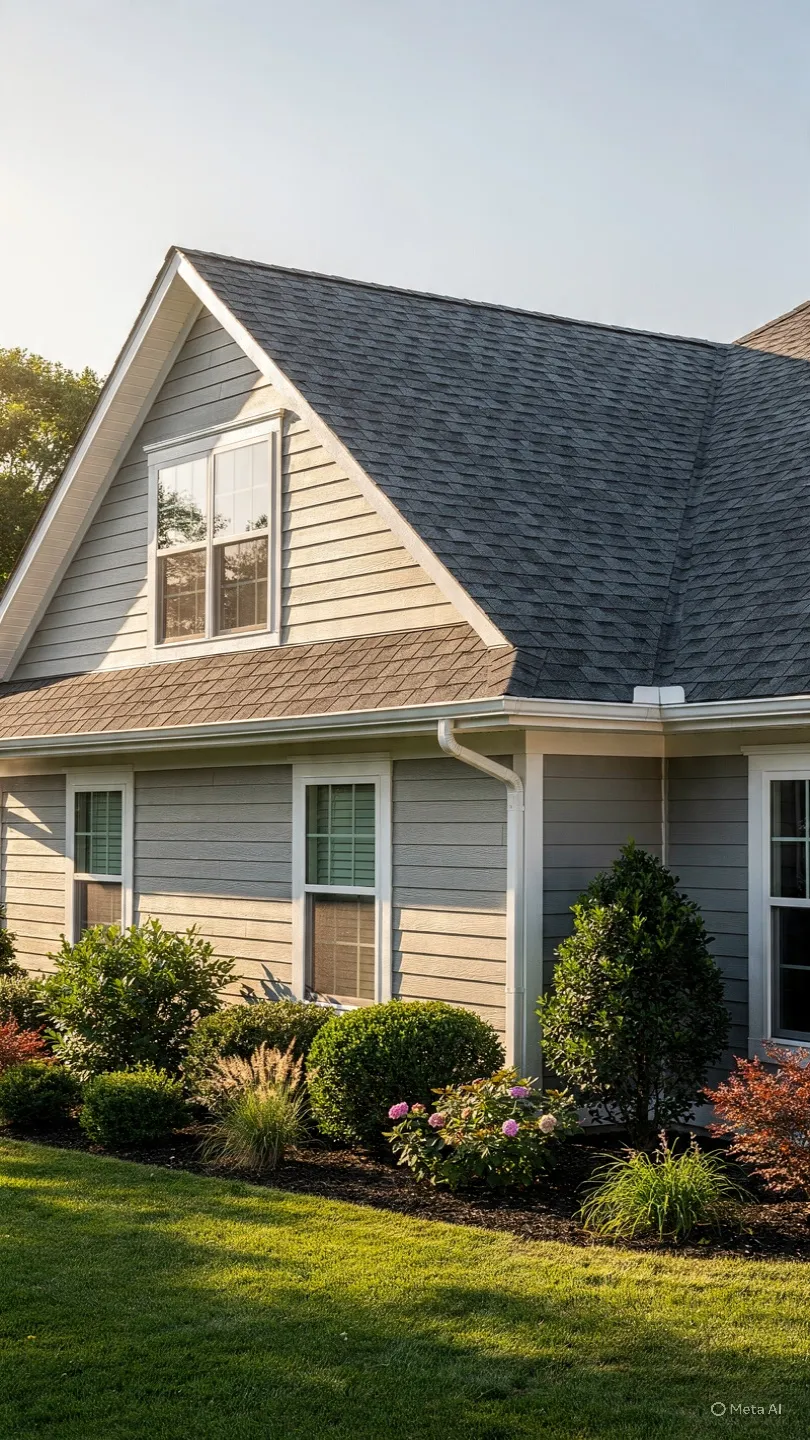
What Does a New Roof Cost in Annapolis? A 2026 Breakdown
What roof replacement actually costs in Maryland in 2026, with every figure dated and sourced. Why your roof is bigger than your house, and how to compare bids.
The average roof replacement cost in Maryland is around $15,212, on a roof of about 21.67 squares, working out to roughly $6.98 per square foot (Maryland roof cost data, retrieved August 2026).
That number is a starting point for budgeting roof replacement in Annapolis, not a quote. This guide shows what sits underneath it: why the advertised prices you’ve seen don’t describe your house, why your roof is bigger than you think, what actually moves a price, and how to put three bids side by side so the comparison means something.
Every figure here carries the date it was retrieved. Roofing prices move with material and labour costs, and an undated number becomes quietly wrong. If you’re reading this well after August 2026, treat these as directional and ask for current pricing.
The short version
| Figure | Retrieved | |
|---|---|---|
| Maryland average replacement | ~$15,212 | Aug 2026 |
| Average roof size | 21.67 squares (2,167 sq ft) | Aug 2026 |
| Average rate | ~$6.98 / sq ft | Aug 2026 |
| Architectural asphalt | $450-650 / square installed | Aug 2026 |
| 3-tab asphalt | $300-500 / square installed | Aug 2026 |
| Standing seam metal | $800-1,200 / square installed | Aug 2026 |
| Second layer tear-off | adds $800-1,500 | Aug 2026 |
| Labour share of project | ~60% | Aug 2026 |
| Resale return, mid-range asphalt | 61.3% | Remodeling Cost vs. Value, South Atlantic |
A square is roofing’s unit of area: 100 square feet. Quotes are built in squares, so it’s worth getting comfortable with it.
What does $3,999 actually cover?
Several companies advertising in this market lead with roofs “from $3,999.” The figure is real. What it describes is narrower than most readers assume: up to 14 squares, with a single layer of tear-off.
Set that against the state average of 21.67 squares and the gap is immediate. The advertised roof is roughly two-thirds the size of the average one. Before any of the conditions that actually drive cost.
So the teaser is accurate for a small, simple, single-layer roof. If that’s your house, it’s a genuine price. The failure mode isn’t dishonesty in the advertisement; it’s that most houses aren’t that house, and the number sets an expectation that the measured quote then has to climb down from.
The useful reframe when a bid comes in far below the others: not “why are they cheaper?” but “which line items are missing?” Almost always the answer is in the decking allowance, the ventilation work, the flashing, or the underlayment spec.
Why your roof is bigger than your house
A 2,000 square foot house does not need 2,000 square feet of roofing. It typically needs 2,400-2,600. Two reasons:
Pitch. A roof is a slope. The steeper the slope, the more surface sits above the same footprint, the difference between the base of a triangle and its two sides. Pitch also raises labour cost, because steep roofs need staging and crews work slower on them.
Overhang. Eaves and rakes extend beyond the exterior walls. That’s roof area over no conditioned space at all, and it still needs covering.
Together these usually make the roof 20-30% larger than the building footprint.
This is worth understanding for one practical reason: a quote produced from your home’s listed square footage is a guess. Any estimator working from tax records or a listing rather than a measured roof is estimating, and estimates get corrected during the job, always upward. Ask whether the roof was measured.
What moves the price
Pitch. Steeper is more expensive in both labour and staging. Very steep roofs may need roof jacks and harnesses throughout.
Existing layers. A second layer of shingles adds roughly $800-$1,500 in tear-off labour and disposal (retrieved August 2026). Some roofs carry three. Tear-off is also when hidden problems surface, which is why a contractor who proposes shingling over an existing layer is proposing not to look.
Decking condition. Soft, delaminated or rotten sheathing must be replaced, and it’s genuinely not visible until tear-off. This is the single most common source of mid-job cost increases, and the one a good contract handles in advance by naming a decking allowance: how many sheets are included and the price per additional sheet. Get that number in writing before work starts.
Ventilation. Inadequate intake or exhaust cooks shingles from underneath and shortens their life materially. Correcting it during a re-roof is cheap. Correcting it afterwards is not, and most manufacturer warranties are void without adequate ventilation.
Wind rating. Higher-rated shingles cost more, and reaching the rated wind speed usually requires an enhanced nailing pattern, commonly six nails per shingle rather than four. Near open water this matters.
Complexity. Valleys, dormers, skylights, chimneys and multiple intersecting planes each add flashing work and cut waste. A simple gable and a cut-up roof of the same area are not the same job.
Access. Tight urban lots, long carries from the street, and landscaping that has to be protected all add labour.
Labour is roughly 60% of the project price (retrieved August 2026). This is the fact that explains most of what looks strange about roofing quotes: material choice moves the number less than people expect, and everything affecting how long the job takes moves it more.
Materials, and what they cost
Architectural asphalt, $450-650 per square installed (retrieved August 2026). The default for most Annapolis homes. Dimensional appearance, better wind ratings and longer life than 3-tab, and the best balance of cost and performance for the majority of houses.
3-tab asphalt, $300-500 per square installed (retrieved August 2026). The older flat-profile product. Cheaper up front, shorter life, lower wind ratings. On most houses the saving is not worth the shorter cycle, though it still has a place on outbuildings and rentals.
Standing seam metal. $800-1,200 per square installed (retrieved August 2026). Substantially more up front, and a service life that can double asphalt’s. Worth genuine consideration on waterfront properties, on low-slope sections where asphalt isn’t rated to perform, and where you intend to stay long enough to see the second half of the life cycle.
Slate and cedar are their own category, priced per project rather than usefully per square. In the Historic District they may not be optional. Replacement in kind is preferred where the material survives and remains serviceable. See our guide to Historic District roofing and HPC approval before making a material decision on a historic property.
What makes a quote go up mid-job
In rough order of how often we see it:
- Rotten decking
invisible until tear-off. Handled by a stated allowance.
A second or third layer nobody knew about, adding tear-off and disposal.
Ventilation correction identified once the roof is open.
- Chimney and flashing work
old flashing frequently can’t be reused, and mortar joints may need repointing.
- Structural repair
rare, but sagging rafters or damaged framing must be corrected before the new roof goes on.
Every one of these is more honest as an allowance in the contract than as a surprise in week two. When you’re comparing bids, a quote that explicitly prices these contingencies isn’t padded. It’s the one that has thought about them.
How do I compare three bids fairly?
Bids are only comparable when the specifications are, and this is where most homeowners lose money. Ask every contractor to put the following in writing:
- Measured roof area in squares: and confirmation the roof was measured, not estimated from floor area
- Exact shingle line and colour, not just the brand
- Underlayment: synthetic or felt
- Ice and water shield coverage: eaves only, or valleys and penetrations too
- Wind rating, and the nailing pattern used to achieve it
- Ventilation: what’s being added or corrected
- Decking allowance: sheets included, price per additional sheet
- Flashing: replaced or reused, and at which details
- Both warranties: manufacturer and workmanship, with terms
- Permit: who files it, and whether the fee is included
- MHIC licence number, plus proof of current liability and workers’ compensation insurance
- Cleanup and disposal: including magnetic nail sweep
Price the same specification three ways and the bids land close together. When one is dramatically lower, put the lists side by side: in nearly every case something above is absent from it. That’s not a bargain, it’s a different job.
Is a new roof worth it at resale?
Partially, and it’s worth being honest about the number. A mid-range asphalt roof replacement returns approximately 61.3% of its cost at resale in the South Atlantic region (Remodeling Cost vs. Value*, South Atlantic region)*.
Read that correctly. It does not mean replacing your roof is a poor decision. A failing roof will be found at inspection, and it will either be negotiated off the price at a rate considerably worse than 61.3% or it will lose you the buyer. It means a new roof is not an investment that pays for itself, and choosing the most expensive option purely for resale value doesn’t hold up.
Getting a real number for your house
Averages tell you whether a quote is plausible. They don’t tell you what your roof costs. That requires the roof measured, the attic checked, the layers established, and the decking condition assessed as far as it can be before tear-off.
For what the work involves start to finish, see roof replacement in Annapolis. If the immediate problem is a leak rather than a replacement decision, roof repair covers the repair-versus-replace framework. And if the damage came from a storm, roof insurance claims in Maryland covers what insurance does and doesn’t pay for.